The short answer
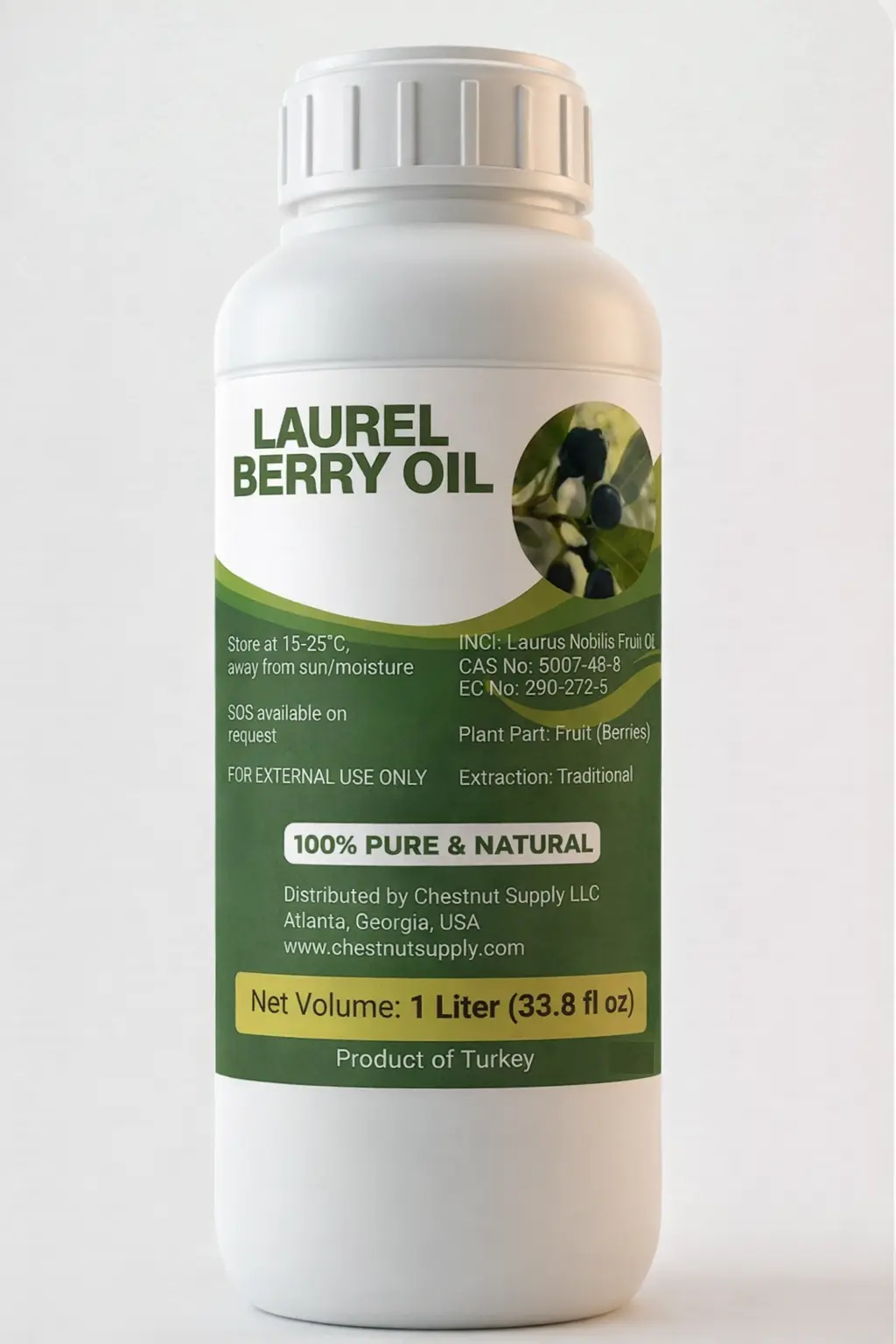
What it is. Laurel berry oil — also written laurel berry fruit oil — is a fixed (fatty) carrier oil. Its INCI name is Laurus Nobilis Fruit Oil.
Which part of the plant. The berries, the fruit of the bay laurel tree — not the leaves. Ours is separated from the boiled berries by traditional water extraction in Hatay, Türkiye.
How it differs from laurel leaf essential oil. The leaf oil (Laurus Nobilis Leaf Oil) is steam-distilled from leaves, is volatile, does not saponify and must be diluted before skin contact. They are not interchangeable. Full comparison →
Why soap makers look it up. It is the oil that makes Aleppo-style soap what it is, and it saponifies: it has its own SAP values (NaOH 0.144, KOH 0.202 on lot LBY2025) and goes into the oil percentages of a recipe. Using laurel berry oil for soap making →
Where to buy
Buy Laurel Berry Oil in the USA → 1 L & 1.25 gal, shipped from Georgia · lot COA on request
Wholesale & bulk laurel berry oil → case, 5 gallon and drum volumes quoted · sample and COA on request
Laurel berry oil is a dense carrier oil made from the fruit of the Laurus nobilis tree, and it is the 2,000-year-old signature ingredient behind authentic Aleppo soap. Many people first hear the name and immediately ask the same questions: Is it the same as bay leaf essential oil, why is it more expensive than common oils, and why do serious buyers keep pointing to Turkey? This guide answers those questions directly and gives you a clear path for personal use or wholesale sourcing.
What Exactly Is Laurel Berry Oil?
Laurel berry oil comes from the small dark berries of the bay laurel tree, not from its leaves. Traditional production starts with hand-harvested berries that are boiled in water so the oil rises and can be collected from the surface. This water extraction method is why high-quality oil usually looks greenish-brown, feels thick, and carries a strong spicy-earthy aroma rather than a light herbal scent. The correct INCI name is Laurus Nobilis Fruit Oil, and for soap makers this matters because it is a true carrier oil that saponifies inside a soap formula.
You will also notice a physical behavior that confuses first-time buyers. Around 70°F / 21°C and below, laurel berry oil can become semi-solid or fully solid. That is normal and not a defect, in the same way coconut oil firms in cooler conditions. It is a property of the oil, not a purity test — adulterated oil can thicken too, so use the COA rather than the texture to judge what you have.
Laurel berry oil is a completely different product from bay laurel essential oil. The essential oil is steam-distilled from the leaves, does not saponify, and is used only for fragrance. If you want a deeper side-by-side comparison, read our dedicated comparison guide.
Laurel Berry Oil vs Laurel Leaf (Bay) Essential Oil
Both come from the same tree, Laurus nobilis, and the names overlap, so listings mix them up often. They are different products:
| Laurel berry oil | Laurel leaf (bay) essential oil | |
|---|---|---|
| Part of the plant | Berries (the fruit) | Leaves |
| Type of oil | Fixed (fatty) carrier oil | Volatile essential oil |
| How it is made | Berries boiled in water, oil collected from the surface (traditional water extraction) | Steam distillation of the leaves |
| INCI name | Laurus Nobilis Fruit Oil | Laurus Nobilis Leaf Oil |
| In soap | Saponifies and counts toward the oil percentages of a recipe | Does not saponify; used in small amounts for scent |
| Typical use | Aleppo-style soap and other soap making, cosmetic formulation | Aromatic use, always diluted |
If your recipe calls for the oil behind Aleppo-style soap, you need the berry oil: buy it by the bottle or jug, or request wholesale pricing. For the full comparison, see laurel berry oil vs laurel leaf essential oil.
A note on "bay oil". Products sold as bay oil or bay rum oil usually come from Pimenta racemosa (West Indian bay), an unrelated tree — neither laurel berry oil nor laurel leaf oil.
Where Does It Come From? Why Hatay, Turkey?
Laurus nobilis is native to the Mediterranean basin, including coastal areas of Turkey, Syria, Spain, Portugal, and Morocco. Even with that broad geography, the strongest commercial reputation today centers on southern Turkey, especially Hatay province near ancient Antioch. Buyers in soap and cosmetic manufacturing prioritize this region because it combines longstanding harvest know-how with a mature supply chain built around laurel and olive traditions.
Hatay stands out for practical agricultural reasons. Mediterranean rainfall patterns, hot summers, and mineral-rich soil create a stable environment where bay laurel trees reach strong fruit yields and reliable oil content. That consistency matters in production because formulators need repeatable raw material behavior, not one season of excellent oil followed by weak batches the next year.
There is also a historical reason. As Syrian Aleppo soap production was disrupted by war, many artisans and families moved operations into Hatay and nearby Turkish zones that already shared similar ecology and soap traditions. The result is continuity of craft in a region with access to the same species, similar climate, and experienced local harvesters.
For village communities in Hatay, berry collection is not a side activity. It is part of seasonal household income, and harvesting knowledge is passed down across generations. That is why direct regional sourcing and per-batch documentation make a difference. Sekiya's laurel berry oil is sourced directly from Hatay partners and every lot is verified through COA documents before release.
What Makes It Different from Other Carrier Oils?
The first difference is fatty acid balance. Laurel berry oil is known for a profile that often includes lauric acid typically around 10 to 30 percent, oleic acid typically around 30 to 50 percent, and linoleic acid typically around 11 to 25 percent. In practical terms, this gives formulators an unusual mix of cleansing support, conditioning feel, and lather performance in one ingredient. Many oils deliver one or two of those benefits well, but fewer deliver all three with this specific character.
The second difference is its unsaponifiable fraction. Compared with many light cosmetic oils, laurel berry oil has a richer non-saponifiable portion, which contributes to its opacity, thickness, and strong botanical identity. That fraction carries terpene compounds and other minor constituents, and is part of why the oil is traditionally chosen for cleansing formulations that need more character than plain olive oil alone.
Its aroma profile is another clear marker. Good laurel berry oil smells bold, spicy, and earthy-plantlike, not soft and floral. In finished soap, that intensity usually softens during cure time, which is one reason artisan makers often like it for character bars. If a blend needs a lighter top note, lavender or eucalyptus essential oils are commonly paired in low amounts.
Finally, there is the temperature behavior. Below roughly 70°F (21°C), it can firm or solidify; when gently rewarmed, it liquefies again without automatic quality loss. That trait is normal and should not be confused with rancidity or contamination.
How Is It Used?
Soap making is the primary use case and the reason this oil is commercially important. Traditional Aleppo-style bars rely on a base of olive oil, laurel berry oil, lye, and water. Depending on formula goals, laurel content typically runs about 12% to 40% in Aleppo-style bars and about 5% to 15% in a general cold-process recipe, where higher percentages are known for stronger cleansing character and richer lather. This is also why makers moving away from weak-foam castile formulas often add laurel for balance. For a full production-focused breakdown, see our laurel berry oil soap making guide, review INCI reference for cosmetic labeling, and if you need finished bars instead of raw oil, review our wholesale Aleppo soap page.
Skin care is a secondary use case, usually in diluted form. Laurel berry oil is traditionally used in cosmetic formulations and is valued by formulators for its fatty acid profile. It is also incorporated into scalp massage blends and body massage oils where a warming herbal carrier is preferred.
In cosmetic formulation, it appears in creams, balms, hair masks, and solid-serum style products, typically in moderated percentages around 5% to 15% depending on texture targets. It can also serve as a core carrier in massage blends when a stronger aromatic profile is desired.
Laurel Berry Oil Benefits
Laurel berry oil benefits come primarily from two sources: its fatty acid profile and its unsaponifiable fraction. The lauric acid content (typically 10–30%) gives it cleansing character and supports lather in soap formulations. Oleic acid (typically 30–50%) delivers conditioning depth, which is why hair and scalp treatments based on laurel berry oil tend to leave a noticeably different feel than lighter carrier oils.
In cosmetic formulation, it is valued for its bold botanical character and traditional Mediterranean heritage. Laurel oil is typically used in diluted form (5–15% in a blend) because its bold aroma and dense texture can feel heavy when used neat. These uses are rooted in Mediterranean folk medicine and are reflected in professional cosmetic practice.
In soap making, the benefits translate directly into bar performance: richer lather than castile, more conditioning feel than pure coconut oil bars, and a characteristic dark-green color that signals premium heritage soap. Many soap makers describe the finished bar as having a distinctly alive, botanical character that plain olive oil cannot replicate on its own.
What to Look for When Buying
Most quality mistakes happen before the oil is even opened, so the label and paperwork should be checked first. Start with the INCI: it must read Laurus Nobilis Fruit Oil. If the listing mentions leaf essential oil as if it were the same item, skip it. Next, assess appearance and odor expectations. Authentic oil is usually opaque greenish-brown, aromatic, and dense. If it is clear, very pale, and almost odorless, you are likely looking at a diluted or substituted product.
Temperature behaviour is a useful first observation, not a test. Laurel berry oil often thickens or solidifies in cool weather; if it stays perfectly thin and transparent at low room temperature, ask direct questions about blend ratio or adulteration. On its own, though, thickening proves nothing — only the batch COA does. Extraction method is another checkpoint. Terms like water extraction or traditional process are consistent with classic laurel berry production, while vague language should prompt follow-up.
Documentation is the non-negotiable part for serious buyers. Ask for lot-specific COA files, not a generic certificate with no batch tie. Country of origin should be explicit, and for premium sourcing the strongest signal is clear Turkey or Syria provenance rather than broad labels like Mediterranean blend. Extremely low pricing in tiny online listings can also signal dilution risk.
For makers planning repeat production, purchase criteria should include supply continuity, not only one-time quality. A dependable wholesale partner should provide stable lots, paperwork discipline, and clear logistics timelines for U.S. delivery. If you are already sourcing for production, start with our wholesale & bulk laurel berry oil page — request a quote, sample, or COA. For sizes, the test-batch-to-bulk path and shipping times, see buying laurel berry oil in the USA. Buying from Canada? Canadian purchases are quoted by email rather than placed online — see our laurel berry oil page for Canadian buyers.
Sekiya's Laurel Berry Oil — Sourced from Hatay
Sekiya sources directly from traditional suppliers in Hatay, Turkey, where laurel harvesting and processing are established craft practices. Oil is produced through traditional water extraction to preserve the expected profile used in Aleppo-style formulations. Each lot is matched with COA data, including core markers such as lauric acid percentage, oleic acid percentage, saponification value and iodine value. Inventory ships from our Georgia warehouse, so U.S. bulk orders move without customs-side uncertainty. Need a bottle or jug rather than a bulk lot? See the laurel berry oil product page.
Ready to Order or Learn More?
If you are ready for a wholesale order, start at /wholesale/laurel-berry-oil. If you are still refining your process, continue with the soap making guide for ratio and handling details. If you want a sample request or direct sourcing support, contact us here: /contact?subject=sample-request.
Verified Laurel Berry Oil Facts
| INCI / CAS | Laurus Nobilis Fruit Oil · CAS 8007-48-5 |
| Extraction | Traditional water extraction — Hatay, Türkiye (single origin) |
| Lauric acid (C12:0) | 13.57% on the current GC-tested lot (COA reference 10–30%) — a marker the leaf essential oil does not carry; read it with the full GC profile rather than on its own |
| SAP value | NaOH 0.144 · KOH 0.202 (derived from lot LBY2025 COA, 201.5 mg KOH/g) |
| Iodine value | 79.8 |
| Documentation | Batch COA on request; full fatty-acid table on the product page |
| Fulfillment | Ships from US stock (Georgia) — current sizes & pricing |
Figures are transcribed from the manufacturer-issued, batch-specific Certificate of Analysis for this lot; the COA for the lot you receive is available on request.